Localization
Last updated 11 days ago
DDEX standards allow to include an XML attribute called LanguageAndScriptCode which enables us to send translations for titles and artist names. Translations can be added in Labelcamp on product and artist pages. However depending on the DSPs, this information will be interpreted differently.
Here is how it works in Labelcamp:
Localize an artist:

From the artist page, one click on the translation icon adds the localized name Localize a Track Title:
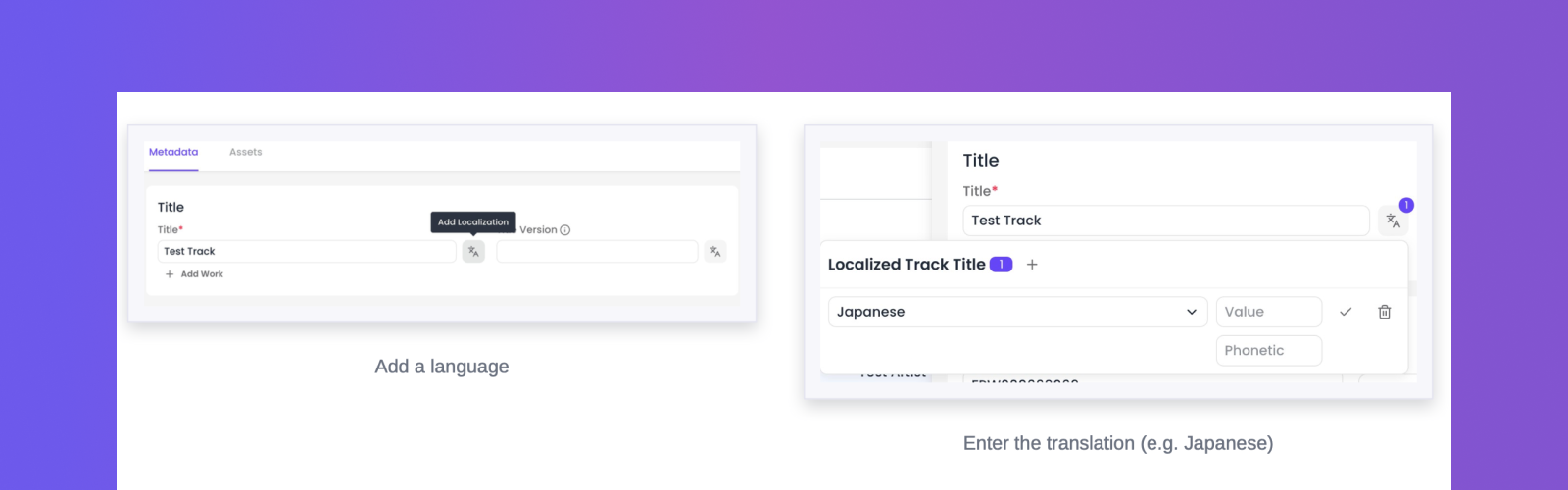
The translation icon next to the title opens a panel to add a localized version per language Localize an Album Title:

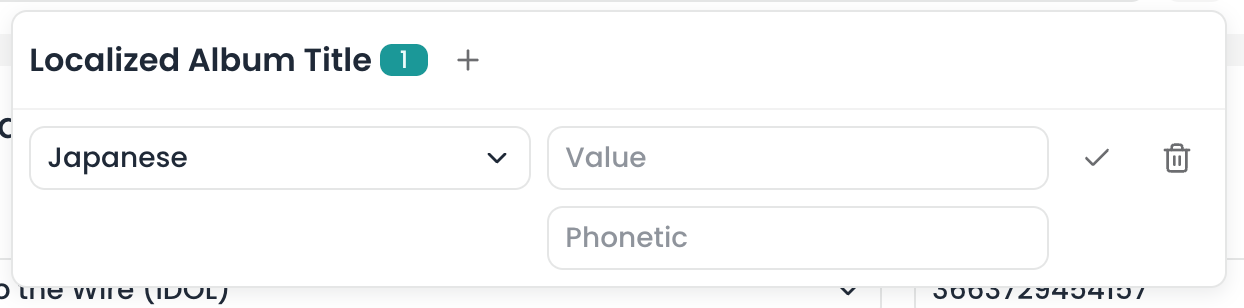
The same mechanism is available at the album level, in the general information The Result:

The translation shows up directly on hover over the icon
Here are the DSPs we are delivering translations to, and their specificities:
Apple Music: Apple supports localization for audio and video releases, including artist names as well as album and track titles and versions. The translations will appear depending on the language UI of the user. ie if a user has their app setup in Japanese, they will see the Japanese translation sent but if it is setup in English, they will view the English default version. The translations are visible in iTunes Connect.
Spotify: Localization on Spotify only works when the ISRC country matches the desired localization language. The translation then replaces the default language everywhere, including for users outside of the target country or not using the specific language UI.
For example if you want to send a Japanese translation, you need to have JP ISRCs on the release. Then the Japanese translations will replace the default english metadata and will be visible everywhere for every user.
Artist names are not automatically localized in the same way as album or track titles. However you can contact Spotify so that they add localized artist names manually.
Accepted languages / ISRCs are : China 'CN', Hong Kong 'HK', Malaysia 'MY', Singapore 'SG', Taiwan 'TW', Indonesia 'ID', Israel 'IL', Turkey 'TR', Greece 'GR', Thailand 'TH', Japan 'JP'.
Amazon Music: Amazon Music can accept localized metadata for title/artist, with numerous localizations accepted per entry (Japanese language metadata is currently the only supported localization in their visual customer experience).
Anghami: Anghami supports the localization feature, artist name and titles translations will be sent and ingested.
Deezer: Localization works for all languages, as long as the translation is sent and the user is using the app of the specific language UI.
Meta: Meta supports language localisation. The user needs their device language (or app locale) set to the local language (e.g., French, Spanish). When that matches a language delivered in the DDEX XML, the storefront will display the localised SongTitle and ArtistName. If the device is set to English, the English metadata will be shown even if local language metadata is available.
Tiktok: Their system stores all localized language artist and title information once it is delivered to them. Removing a translation in an update will not remove it in the app. But changing a translation to a different one is possible. The translations are visible in Mediamatch in the share details release page. It is based on the language setting in the app.
Youtube: Translations are used in the YouTube Music app and on music.youtube.com. Original language text is used in the title and description of the Art Track in YouTube.
Netease: They only support to choose the display title according to language indicated in Audio Language, or if this is a work without lyrics/performance language, they will choose based on the ISRC region.
Flo: Only Korean language is supported for translations. User language preference is not supported. Therefore, if a Korean translation is sent, only Korean metadata will be displayed upon delivery.
Phonetic titles: for some languages, the phonetic translation can also be added for example for Japanese (Katakana). This will make the search easier for users on DSPs.